Basketball packs arenas with fans cheering massive dunks and buzzer-beaters. You might watch a game and wonder about all the lines on the court or why certain shots count more. This guide breaks it down so you can follow every play without confusion.
We’ll cover the court setup, player roles, how games start and flow, scoring details, key rules, and timing. It focuses on NBA basics, with FIBA notes for international play. Rules stay standard in 2026, so grab a snack and dive in.
What the Court Looks Like and Why It Matters
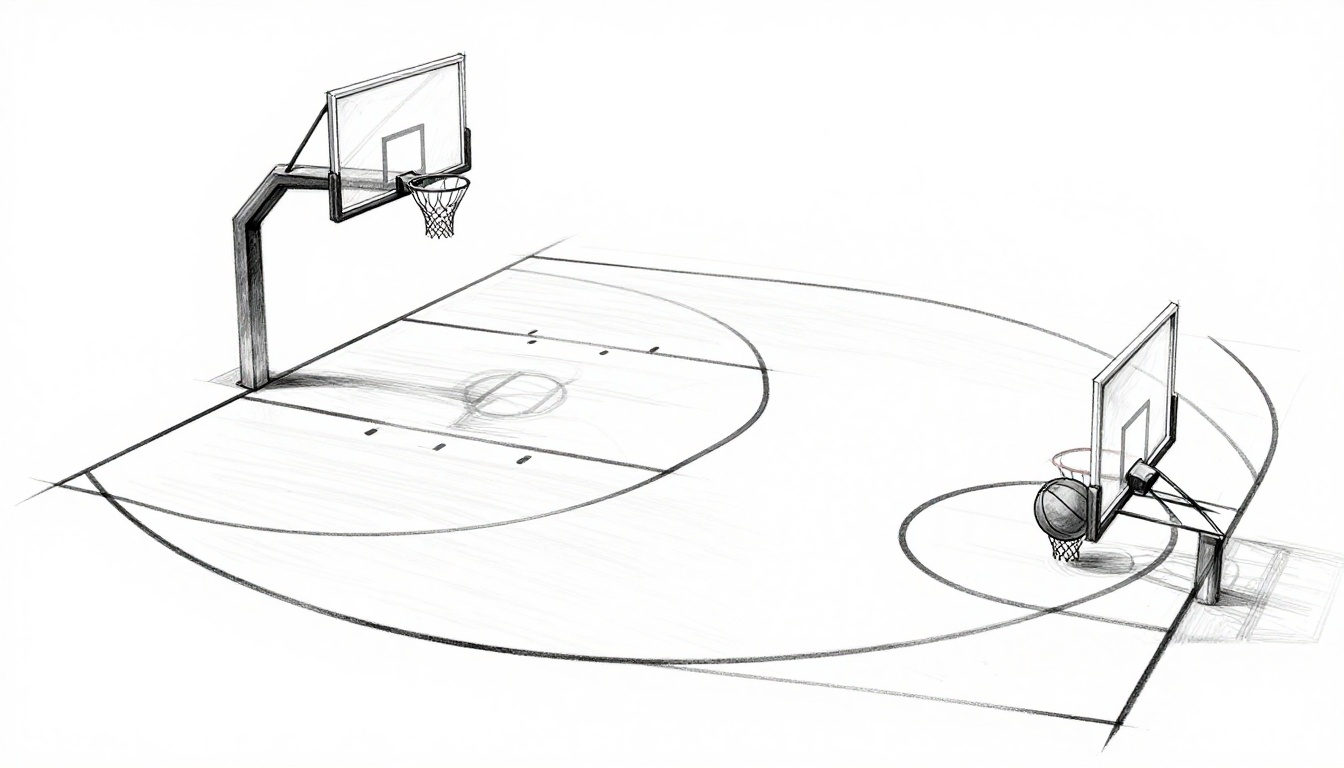
The NBA court measures 94 feet long and 50 feet wide. Picture a big school gymnasium stretched out, with orange rims hanging 10 feet high at each end. Each hoop has an 18-inch diameter, just wide enough for the ball to swish through.
Key lines shape the action. The three-point line sits 23 feet 9 inches from the basket at the top, curving closer at the corners to about 22 feet. Cross it for big points. The paint, or key, forms a rectangle under the basket, 16 feet wide by 19 feet long. The free-throw line arcs 15 feet away. The midcourt line splits the floor in half, and baselines run behind each hoop.
These markings matter because they control where players score and defend. For exact specs, check the NBA’s official court rules. FIBA courts run slightly smaller at 91.9 feet by 49.2 feet. Their three-point line stays uniform at 22 feet 1.75 inches all around. Still, the setup feels familiar across levels.
Hoops mount on glass backboards, 72 inches wide by 42 inches tall. Padding protects players crashing in for rebounds. Sidelines and end lines keep the ball in bounds. Coaches pace along the sidelines, calling plays.
The court guides strategy. Teams attack from the wings or post up inside. Fans spot big moments when players step behind the arc.
Must-Know Zones Like the Paint and Arc
The paint demands respect. Big men own this space for rebounds and close shots. Offensive players can’t linger more than three seconds with the ball here. Defenders follow the same rule.
Near the rim, the charge circle spans 4 feet out. It stops defenders from drawing cheap fouls too easily. The restricted area, a smaller semicircle, blocks certain charges if drivers beat their man.
The three-point arc changes everything. Shoot from there, and you earn three points instead of two. Feet on the line? It counts as two. These zones force smart choices. Teams spread the floor to pull defenders out.
Who Does What: Player Positions and Team Setup
Each team puts five players on the court. They fill roles that blend offense and defense. Point guards run the show. They dribble up court, pass sharply, and set picks.
Shooting guards focus on buckets. They drain jumpers from mid-range or beyond the arc. Small forwards mix it up. Versatile scorers, they guard top opponents and slash to the rim.
Power forwards battle inside. They grab boards, hit hook shots, and screen for teammates. Centers anchor the paint. The tallest players block shots, dunk, and protect the rim.
Teams carry 7 to 12 substitutes. Fresh bodies keep energy high in a sprinting sport. Positions blur in modern play, but basics hold. For detailed roles, see this breakdown of basketball positions.
Balance matters. A strong lineup covers shooting, driving, and rebounding. Coaches match matchups, like posting a center against a smaller foe.
Switching Players In and Out Seamlessly
Substitutions happen only on dead balls. Think after a score, foul, or timeout. Players wave to the referee and report to the scorer’s table.
Why bother? Tired legs lead to mistakes. A quick swap keeps defenses fresh. Unlimited changes let coaches adapt. In the NBA, rosters hit 15 players, but only 13 dress per game.
Referees track fouls per player too. Six personal fouls bench someone for good. Subs add layers to strategy.
From Tip-Off to Action: Starting and Moving the Ball
Games kick off with a jump ball. Two tallest players crouch at center court. The ref tosses the ball up, and they tip it to teammates.
After a score, the other team inbounds from the baseline. They pass across the midcourt line in 10 seconds or lose possession. The 24-second shot clock ticks down. Teams must shoot before it hits zero, or turnover.
Basic flow goes like this: Dribble to advance, pass to open shooters, cut for layups. Defenders swipe at the ball or contest shots. Rebounds start fast breaks.
FIBA uses a 24-second clock too, but their backcourt time differs slightly. Action builds tension as clocks wind down.
Common Moves Like Dribbling Without Breaking Rules
Dribbling keeps it legal. Bounce the ball with one hand while moving. Lift both hands or stop your dribble? Pass or shoot next.
Traveling kills plays. Take no more than two steps without dribbling. Double dribble stops and restarts the bounce. Both cause turnovers.
These rules keep games fair. Players master crossovers and hesitations. Violations speed up play, rewarding quick hands.
How Teams Rack Up Points: Scoring Basics
Field goals form the core. Shots inside the three-point line score two points. Layups slip close, mid-range jumpers arc high, dunks thunder down.
Step outside the arc for three points. Stars like Steph Curry live here. One foot on the line makes it a two-pointer. No changes to this in 2026.
Free throws add one point each from the line. Shooters focus amid pressure. A hot night means 30-plus points easy.
Examples stick. LeBron drives for twos; Curry rains threes. Teams mix shots for max damage.
Earning Free Throws After Fouls
Fouls trigger bonuses. In the NBA, teams hit five fouls per quarter. Then, non-shooting fouls send opponents to the line.
Fouled inside the arc? Two free throws. Behind it on a three attempt? Three shots. And-one means shoot after a made basket.
FIBA bonuses kick in after four quarter fouls. Clear penalties reward contact. Stars shine here, boosting leads.
Rules to Play By: Fouls, Violations, and Penalties
Personal fouls hit hard. Pushing, holding, or hacking sends foes to the line. Most lead to free throws or turnovers.
Violations include shot clock buzzers or three seconds in the paint. Goaltending slaps away shots on the downswing. Block before the peak? Legal in NBA, stricter in FIBA.
Teams track fouls. Bonus situations ramp up pressure. Check examples in the NBA Video Rulebook.
Penalties maintain order. Turnovers give the ball away; free throws punish aggression.
Technical Fouls and Keeping It Clean
Techs call out antics. Yelling at refs or hanging on the rim earns one free throw plus possession.
Repeat offenses eject players. Sportsmanship rules. Coaches get them too for arguing.
Clean play earns respect. Fans boo dirty tactics, cheer hard fouls.
Timing the Game: Quarters, Breaks, and Winning
NBA games split into four 12-minute quarters. Halftime lasts 15 minutes. FIBA quarters run 10 minutes with two-minute halves.
Clocks stop for fouls, timeouts, or out-of-bounds. Buzzer ends periods. Ties go to five-minute overtime.
Timeouts refresh plans. NBA teams get seven per game, more if behind late. FIBA limits to two first half, three second.
Most points win. Final buzzer seals it. Drama peaks in closing seconds.
Basketball thrives on court lines that guide shots, positions that team skills, and flow from tip-offs that build drama. Scoring rewards bold plays, rules keep it fair, and tight timing adds urgency.
Catch an NBA game tonight or hit a local court. Which rule surprised you most? Share below or subscribe for more sports breakdowns.